How to Choose the Right Swimming Pool Finish for Your Climate
A practical guide to choosing the right swimming pool finish for your climate, comparing plaster, quartz, pebble, tile, and fiberglass.
How to Choose the Right Swimming Pool Finish for Your Climate: 7 Key Factors
How to choose the right swimming pool finish for your climate is a question that gets overlooked far too often during pool planning, usually in favor of picking whatever finish looks best in a brochure photo. That’s a mistake, because a finish rated for a decade of service in one climate can fail in half that time somewhere else. A plaster finish that lasts 10 to 15 years in a mild, inland climate might only survive 5 to 8 years in a humid coastal environment with heavy salt air and intense UV exposure.
The pool finish is the surface you’ll touch, look at, and maintain for years, and it directly affects water color, swimmer comfort, stain resistance, and how often you’ll need to resurface. What most comparison guides miss is that climate isn’t a minor detail in this decision, it’s often the deciding factor. Freeze-thaw cycling, intense UV exposure, high humidity, salt air, and hard water all wear down pool surfaces at dramatically different rates, and the finish that performs beautifully in Arizona can be the wrong choice entirely in coastal South Carolina or the Northeast.
This guide walks through how to choose the right pool finish for your climate, covering the major finish types, how each one holds up under different environmental stress, and the specific factors, UV exposure, freeze-thaw cycling, humidity, and water chemistry, that should actually drive your decision. Whether you’re building a new pool or resurfacing an aging one, matching your finish to your climate will save you real money and frustration over the life of your pool. Let’s break down what actually works where.
Why Climate Should Drive Your Pool Finish Decision
Most pool finish comparisons are written as if every pool exists in a climate-neutral vacuum, but that’s simply not how these surfaces perform in the real world. A pool finish is a cement-based, tiled, or gelcoat surface exposed to sun, water chemistry, and temperature swings around the clock, every day, for years. Ignoring climate when choosing a finish is one of the most common and costly mistakes homeowners make, since a finish that performs well in an arid climate can fail significantly faster in a humid, salt-air environment, and vice versa.
1. Understand the Main Pool Finish Types
Before matching a finish to your climate, it helps to know what’s actually available. Most in-ground concrete pools use one of the following:
Standard Plaster
Plaster is a smooth blend of white or pigmented marble dust and cement, and it remains the most common and affordable pool finish nationally. It delivers the lowest upfront cost but also the shortest service life, typically requiring a re-coat every 7 to 10 years even in moderate climates, and considerably sooner in harsher ones.
Quartz Aggregate
Quartz finishes blend crushed quartz crystals into the plaster mix, boosting stain and chemical resistance while adding subtle color and texture. Quartz sits in a strong middle ground, more durable than plain plaster, smoother underfoot than pebble, and typically offering 12 to 18 years of service life.
Pebble Aggregate
Pebble finishes, such as Pebble Tec, embed natural river pebbles or manufactured aggregate into the cement, creating a textured, organic surface. Pebble is generally the most durable cementitious option, often lasting 15 to 20 years or more, though the texture can feel rougher underfoot and isn’t always the most comfortable choice for very young children.
Tile
Tile finishes, ceramic or glass, offer the most design flexibility and the longest genuine lifespan of any common finish, since tile itself is largely unaffected by the mineral leaching that degrades cement-based surfaces over time. It’s also the most expensive option and the most labor-intensive to install.
Fiberglass Gelcoat
Fiberglass pools come with a factory-applied gelcoat finish that’s smooth, non-porous, and low-maintenance by design. Because it isn’t cement-based, it avoids many of the mineral and chemical degradation issues that affect plaster, quartz, and pebble, though when a gelcoat does eventually fail, resurfacing options are more limited than for a concrete shell.
2. Factor In UV Exposure and Altitude
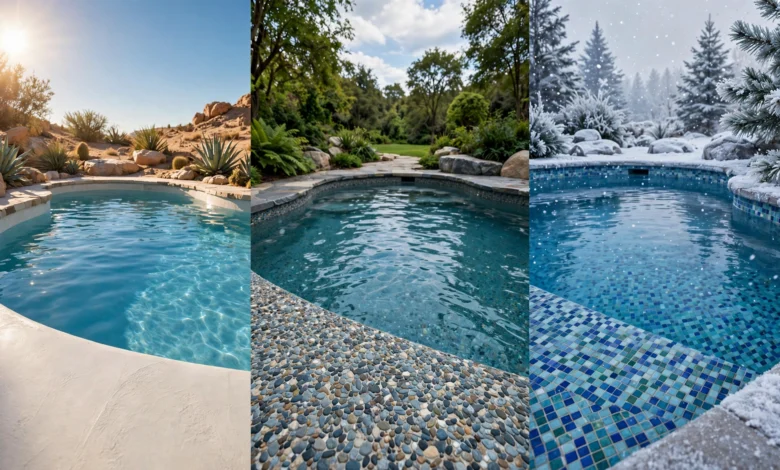
Intense, sustained sunlight is one of the most aggressive forces acting on a pool finish, and it varies significantly by region. UV radiation oxidizes cement-based surfaces over time, causing mottling in plaster and fading the cement between pebble and quartz aggregates. States with especially intense sun exposure, including much of the Southwest and high-altitude regions where UV intensity increases with elevation, put extra stress on cementitious finishes.
- Tile and specialized UV-resistant coatings hold up best in consistently intense sun.
- Pebble and quartz degrade more slowly than standard plaster under heavy UV exposure.
- Standard plaster is the most vulnerable to UV-driven fading and surface mottling over time.
3. Account for Salt Air and Coastal Humidity
Coastal climates introduce a specific challenge that inland comparison guides often miss entirely: salt-laden humidity. Cement-based finishes, plaster, pebble, and quartz, are all porous to some degree, and salt air accelerates the mineral leaching that degrades these surfaces over time. A plaster finish rated for a decade of service inland may only last 5 to 8 years in a consistently humid, salt-air coastal environment. Pebble and quartz generally hold up better than plain plaster in these conditions, but the cement matrix between the aggregates still degrades faster than it would inland.
- Tile and fiberglass gelcoat are the most resistant to salt-air degradation, since neither relies on a porous cement matrix.
- Pebble and quartz offer a meaningful durability improvement over plaster in coastal environments, though they aren’t immune to the effects.
- Standard plaster is the finish most likely to underperform its rated lifespan near the coast.
4. Plan for Freeze-Thaw Cycling in Cold Climates
In regions with genuine winter freezes, temperature swings between freezing and thawing create expansion and contraction stress that can crack or delaminate a poorly matched pool finish. According to guidance compiled by pool resurfacing specialists serving the Mid-Atlantic and Northeast, freeze-thaw cycling can seriously damage finishes that aren’t installed correctly or chosen appropriately for cold-climate conditions.
For climates with real winter freezes:
- Pebble and quartz tend to handle freeze-thaw stress better than standard plaster, since their aggregate content adds structural flexibility.
- Proper installation matters as much as finish choice, since even a durable finish can fail if it wasn’t installed correctly for cold-climate conditions.
- Winterization procedures vary by finish type, so confirm your specific finish’s seasonal shutdown requirements with your installer.
5. Consider Hard Water and Calcium Content
Regional water chemistry has a direct, ongoing effect on how a pool finish performs and looks over time. Areas with high calcium content in the water supply accelerate the buildup of scale on plaster and other cementitious surfaces, and combined with intense UV exposure, this can cause noticeably faster deterioration than the same finish would experience in a region with softer water. Regular acid washing can restore a scaled plaster surface’s smoothness, but each treatment also removes a thin layer of material, gradually shortening the finish’s overall lifespan.
If your local water supply runs hard, quartz or pebble finishes generally tolerate mineral buildup better than standard plaster, and a consistent water-balancing routine becomes even more important regardless of which finish you choose.
6. Match Finish Texture to How the Pool Will Be Used
Climate isn’t the only practical factor, how your household actually uses the pool matters just as much when weighing texture and comfort:
- Families with young children often prefer the smoother feel of plaster or quartz over the more abrasive texture of pebble.
- Pools used heavily for active swimming, sliding, or pool games may find pebble’s texture less comfortable during extended contact with skin.
- Pools prioritizing slip resistance around steps and entry points benefit from pebble’s naturally textured surface, even if the rest of the pool uses a smoother finish.
7. Weigh Long-Term Cost Against Upfront Price
A finish decision driven purely by upfront cost often ends up more expensive over the life of the pool, particularly in demanding climates. Plaster typically costs less per square foot to install initially, but its shorter lifespan in harsh climates means more frequent resurfacing. Quartz and pebble cost more upfront but generally deliver a better cost-per-year of service in climates with intense UV, salt air, hard water, or freeze-thaw cycling.
Quick Comparison by Climate Challenge
| Climate Factor | Best-Performing Finishes | Weakest Option |
|---|---|---|
| Intense UV / high altitude | Tile, pebble, quartz | Standard plaster |
| Coastal salt air / humidity | Tile, fiberglass gelcoat | Standard plaster |
| Freeze-thaw cycling | Pebble, quartz | Standard plaster |
| Hard water / high calcium | Quartz, pebble | Standard plaster |
Practical Steps Before Choosing Your Finish
- Identify your climate’s primary stress factor – UV, salt air, freeze-thaw, or hard water often dominate, but many regions face more than one.
- Ask your contractor for climate-specific performance data, not just national averages, since a finish’s rated lifespan can vary dramatically by region.
- Request physical samples and view them in your own outdoor light next to your deck material, since printed brochures and digital images don’t accurately represent how a finish looks underwater.
- Confirm installer certification for specialized finishes like pebble or quartz, since improper installation can undermine even the most climate-appropriate material choice.
- Follow startup and curing procedures exactly, since skipping them on cementitious finishes can void warranties and cause permanent surface damage within the first weeks.
Conclusion
Learning how to choose the right swimming pool finish for your climate comes down to identifying which environmental stresses your region places on a pool surface, intense UV, coastal salt air, freeze-thaw cycling, or hard water, and matching your finish choice accordingly rather than defaulting to whatever looks best in a showroom photo. Standard plaster remains the most affordable option but is also the most vulnerable across nearly every demanding climate condition, while quartz, pebble, and tile each offer meaningfully better durability where UV, salt, cold, or mineral content would otherwise shorten a finish’s useful life. Get this decision right from the start, and you’ll spend less on resurfacing, enjoy better long-term water quality, and end up with a pool surface built to actually last in the conditions it faces every day.