10 Swimming Pool Safety Tips Every Homeowner Should Know
Ten essential swimming pool safety tips every homeowner should know to protect children and guests and prevent drowning at home.
10 Swimming Pool Safety Tips Every Homeowner Should Know
Swimming pool safety tips every homeowner should know matter far more than most people assume, because a backyard pool is statistically one of the more dangerous features of a home when the right precautions aren’t in place. Drowning is the leading cause of death for children ages 1 to 4 in the United States, and according to the Centers for Disease Control and Prevention, most young drowning victims weren’t even expected to be near the water at the time.
That statistic alone should reframe how most homeowners think about pool safety. It’s rarely a case of a child swimming unsupervised and getting into trouble, it’s far more often a case of a child wandering into a pool area nobody realized they had access to. That’s precisely why pool safety experts talk about “layers of protection” instead of a single fix: no one measure, not a fence, not supervision, not swim lessons, is enough on its own.
This guide walks through the 10 most important swimming pool safety tips every homeowner should have in place, from physical barriers and alarms to supervision habits and emergency preparedness. Whether you’ve had a pool for years or just installed one, these are the fundamentals that genuinely reduce risk, backed by guidance from national safety and health authorities rather than guesswork. Let’s go through them one at a time.
Why Pool Safety Deserves Serious Attention
Pool ownership comes with real responsibility, and the numbers back that up. The U.S. Consumer Product Safety Commission reports that, on average, there are 379 fatal pool-or-spa drownings involving children younger than 15 each year in the United States. Drowning also happens fast and silently, often within seconds, and without the splashing or shouting people expect from movies. That combination, speed and silence, is exactly why proactive home pool safety measures matter more than reactive ones.
1. Install a Compliant Four-Sided Pool Barrier
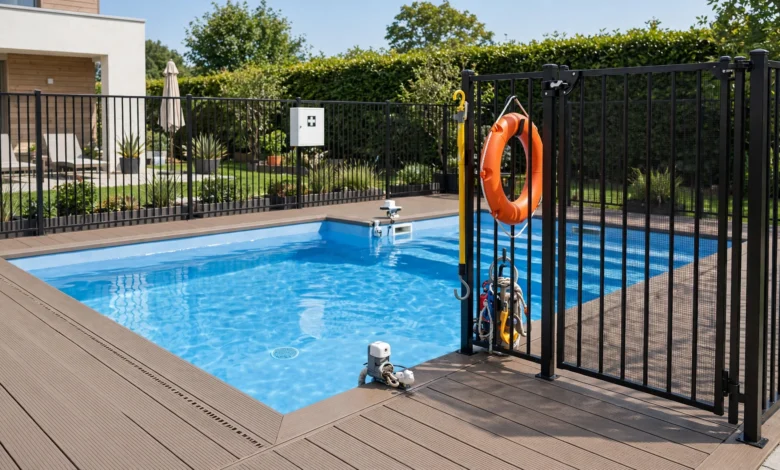
The single most effective physical safety measure you can install is a proper pool fence or barrier that completely separates the pool from the rest of the yard and the house. Research cited by the CDC found that a four-sided isolation fence, one that fully separates the pool area from both the house and the yard, reduces a child’s drowning risk by 83% compared to a three-sided property-line fence that uses the house as one wall.
Key features of an effective pool barrier:
- At least four feet high, with many states requiring five feet
- No gaps, footholds, or climbable elements a young child could use to get over or through
- Fully separates the pool from the house, not just the property line
2. Use Self-Closing, Self-Latching Gates
A fence is only as effective as its weakest access point, and that’s almost always the gate. Every gate providing access to the pool area should be self-closing and self-latching, so it locks automatically even if someone forgets to close it behind them. The latch release mechanism should be positioned high enough, and far enough from any opening, that a young child can’t reach it by climbing or reaching through the fence. Gates should also open outward, away from the pool, so a child pushing against it from the pool side can’t force it open.


3. Add Door and Window Alarms Where the House Forms Part of the Barrier
If your home’s wall forms part of your pool enclosure, additional layers of protection matter even more. Door alarms on any door leading directly from the house to the pool area alert you the moment it opens, giving you a critical few seconds of warning if a child wanders toward the water unsupervised. Combined with a physical barrier, this creates the kind of layered protection safety experts consistently recommend rather than relying on any single measure.
4. Designate an Active “Water Watcher” During Every Swim Session
Supervision sounds obvious, but the CDC specifically recommends assigning one dedicated adult, a “water watcher,” whose only job during a swim session is watching the children in or near the pool. This person shouldn’t be reading, scrolling on a phone, or engaged in conversation, because drowning happens fast enough that even a brief lapse in attention can be too long. At larger gatherings, rotating this responsibility every 15 to 20 minutes between sober adults helps keep supervision genuinely active rather than assumed.
Supervision Best Practices
- Stay within arm’s reach of young children and infants in or near the water.
- Never leave a child alone in or near a pool, even for a moment.
- Avoid distractions like phones, alcohol, or extended conversations while supervising.
- Assign a specific adult to each child at gatherings with multiple children present.
5. Enroll Children (and Adults) in Formal Swim Lessons
Swimming ability is one of the most effective, and most overlooked, layers of drowning prevention. Formal swim lessons are associated with a significantly lower drowning risk among young children, and the American Academy of Pediatrics and CDC recommend most children begin formal lessons starting around age one. It’s worth noting that swim lessons reduce risk, they don’t eliminate it. Children who know how to swim still need close, constant supervision around water.
6. Learn CPR and Keep Rescue Equipment Poolside
Every adult responsible for supervising a pool should know CPR and basic emergency water rescue techniques. Seconds matter in a drowning emergency, and being able to begin resuscitation immediately, before emergency services arrive, meaningfully improves outcomes. Alongside CPR knowledge, keep the following within easy reach of the pool at all times:
- A reaching pole or shepherd’s hook
- A ring buoy or throwable flotation device
- A charged phone for calling emergency services
- A clearly posted list of the pool address, in case a babysitter or guest needs to give it quickly during a 911 call
7. Remove Toys and Floats From the Pool When It’s Not in Use
An empty pool with toys still floating in it is an invitation for a curious child to lean in, reach for something, and fall. After swim time ends, clear the pool surface of any toys, floats, or inflatables that might attract a child’s attention when no adult is actively supervising. This small habit removes one of the more common triggers for unsupervised pool access.
8. Secure Above-Ground Pool Ladders and Access Points
Above-ground pools present a specific risk that in-ground pools don’t: a ladder or set of steps left in place gives a young child a direct path to climb up and fall in. The Consumer Product Safety Commission has specifically flagged this risk in recent safety reports, including recalls tied to above-ground pool components that created accessible footholds. When the pool isn’t in use, remove or lock ladders and steps so they can’t be used without adult assistance, and check that any pool cover or barrier is fully secured.
9. Use a Pool Cover as an Additional Layer, Not a Replacement for Supervision
A power safety cover rated to support the weight of a child or adult can serve as an additional layer of protection, particularly during off-season months or when the pool isn’t in regular use. It’s important to be clear about what a cover can and can’t do: an approved safety cover is a supplemental barrier, not a substitute for a compliant fence, active supervision, or the other layers of protection discussed here. Standard floating solar covers or decorative covers are not designed to bear weight and should never be relied on as a safety measure.
10. Educate Guests, Babysitters, and Extended Family on Your Pool Rules
Drownings often happen at gatherings or during moments when regular supervision routines break down, a grandparent watching a grandchild who doesn’t know the pool rules, a babysitter unfamiliar with the gate latch, or guests assuming someone else is watching the kids. Take a few minutes to walk anyone supervising your pool through:
- Where the gate latch is and how it works
- The location of rescue equipment and how to use it
- Your household’s specific supervision expectations (no phones while watching kids, designated water watchers, etc.)
- What to do and who to call in an emergency
This simple communication step closes one of the most common gaps in home pool safety, the assumption that everyone already knows the rules.
Building These Layers Into a Complete Safety System
No single item on this list is a complete solution on its own. A compliant fence with a self-latching gate dramatically reduces risk, but it doesn’t replace active supervision. Swim lessons build a critical skill, but they don’t make a child drown-proof. The strongest approach to pool safety combines physical barriers, supervision habits, skill-building, and emergency preparedness together, so that if one layer fails, another is still in place to prevent a tragedy.
Conclusion
These 10 swimming pool safety tips every homeowner should know aren’t a checklist to complete once and forget, they’re an ongoing system that needs to stay in place for as long as a pool is on the property. A compliant four-sided barrier with a self-latching gate, active water-watcher supervision, formal swim lessons, CPR knowledge, and clear rules for anyone else watching the pool together form the layered protection that genuinely prevents drowning. Given how quickly and quietly drowning can happen, and how often it involves a child who wasn’t expected to be near the water, treating these measures as non-negotiable rather than optional is one of the most important responsibilities that comes with owning a pool.