How to Avoid Common Contractor Scams
Learn how to avoid common contractor scams with practical steps covering licensing, contracts, payments, and warning signs to watch for.
9 Proven Ways to Avoid Common Contractor Scams
Introduction
How to avoid common contractor scams is a question that becomes urgent fast, usually right after a storm, a flood, or some other event that leaves homeowners scrambling to get repairs done quickly. That urgency is exactly what scammers count on. They show up with a convincing pitch, a suspiciously low price, and a story about why you need to sign today, and by the time a homeowner realizes something’s wrong, the money is already gone.
Contractor scams aren’t limited to disaster zones, though. They happen year-round, in every part of the country, targeting homeowners who are simply trying to get a kitchen remodeled, a roof replaced, or a driveway repaved. The tactics tend to repeat themselves: a demand for a large upfront payment, pressure to decide immediately, vague or missing paperwork, and a business that seems to have no permanent address or verifiable history.
This guide breaks down the specific, practical steps that make it much harder for a scammer to succeed, along with the common scam patterns to recognize before they cost you money. Whether you’re hiring for a small repair or a major renovation, these habits apply across the board, and they’re worth building into your process before you ever sign a contract or hand over a deposit.
Why Contractor Scams Are So Common
Home improvement fraud remains one of the most frequently reported categories of consumer complaints in the country. According to the Federal Trade Commission, scammers often target older homeowners, disaster-affected neighborhoods, and people under time pressure to get repairs done quickly, precisely because urgency makes people skip the due diligence they’d normally do.
The good news is that most contractor scams follow recognizable patterns. Once you know what to look for, it becomes much easier to spot a scam before you’ve committed any money, rather than after.
9 Proven Ways to Avoid Common Contractor Scams
1. Verify Licensing and Insurance Before Signing Anything
This is the single most effective step in avoiding a scam. Ask for a license number and confirm it directly through your state or local licensing board’s website, rather than trusting a number printed on a business card or truck door. Also request proof of general liability insurance and, where applicable, workers’ compensation coverage.
- Confirm the license is active, not expired or suspended.
- Check that the license type matches the specific work being done.
- Call the insurance provider directly to confirm coverage is current if the project is significant in size.
2. Be Wary of Storm Chasers and Door-to-Door Solicitors
After severe weather events, it’s common for out-of-town crews to move through affected neighborhoods offering fast repairs. Some are legitimate, but many operate without local licensing, disappear after collecting a deposit, or perform substandard work with no way to follow up afterward.


Be especially cautious of anyone who:
- Shows up unsolicited and claims to have “noticed damage” on your property
- Pressures you to sign a contract on the spot
- Has no local address, phone number, or verifiable business history
- Offers to handle your insurance claim directly in exchange for a cut of the payout
3. Never Pay a Large Deposit Upfront
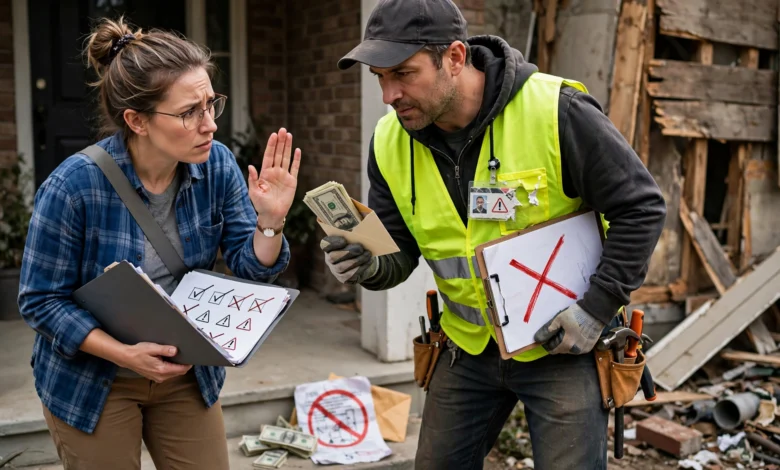
A reasonable deposit generally falls between 10% and 30% of the total project cost. Scammers often ask for 50% or more, sometimes the full amount, before any work begins. Once that money changes hands, there’s often little recourse if the contractor disappears.
Structure payments around completed milestones instead:
- A modest deposit to secure the start date
- Progress payments tied to specific, verified stages of work
- A final payment withheld until the job passes inspection and you’re satisfied
4. Get Everything in a Detailed Written Contract
Scammers frequently avoid putting anything in writing, or they offer a vague, one-page document with no real detail. A legitimate contract should include:
- A full description of the scope of work and materials
- Total cost and a clear payment schedule
- Start and estimated completion dates
- A defined process for handling any changes to the scope
- Warranty terms for labor and materials
If a contractor resists documenting these details, treat it as a serious warning sign rather than something to work around.
5. Watch for High-Pressure Sales Tactics
Urgency is one of the most reliable indicators of a scam. Phrases like “this price is only good today” or “I have leftover materials from another job so I can do yours cheap right now” are designed to short-circuit your normal decision-making process.
A legitimate contractor understands that hiring someone for home improvement work is a significant financial decision and will give you time to review the contract, get other quotes, and ask questions without pushing you toward an immediate signature.
6. Check References and Reviews Across Multiple Platforms
Look beyond the reviews a contractor hands you directly. Check Google, the Better Business Bureau, and trade-specific platforms for a broader picture. According to the Better Business Bureau, consistent complaint patterns, particularly around unfinished work or unreturned deposits, are a strong signal that a business isn’t operating in good faith.
Ask for references from projects completed within the last year, and call them directly. Ask specific questions about communication, timeliness, and whether they’d hire the same contractor again.
7. Be Cautious of Unusually Low Bids
A bid that’s dramatically lower than every other quote you’ve received is one of the clearest contractor scam warning signs. It often means the contractor plans to cut corners on materials, use unlicensed subcontractors, or pad the final invoice with unexpected charges once the project is underway and you’re less able to walk away.
Get at least three quotes and compare scope of work in detail, not just the total price, before assuming a lower number is simply a better deal.
8. Confirm Permits Are Being Handled Properly
Licensed contractors typically pull permits themselves as part of the job, since permitting is tied directly to their license and accountability. If a contractor asks you to pull permits under your own name, or tells you the project “doesn’t need permits” when other contractors have said otherwise, that’s worth questioning directly.
Skipping permits shifts legal responsibility onto you and can create serious problems if the work fails inspection or causes issues when you eventually sell your home.
9. Pay by Traceable Methods, Never Cash
Always pay by check, credit card, or another traceable method that creates a clear record. Cash payments are harder to trace and often give you fewer options if you need to dispute a charge later. Many credit cards also offer purchase protection that can help recover funds if a contractor fails to deliver the agreed work.
Common Types of Contractor Scams to Recognize
Understanding the specific tactics scammers use makes it easier to recognize them in the moment:
- The disappearing deposit: A contractor collects a large upfront payment and never starts the work, or starts and then vanishes partway through.
- Bait-and-switch pricing: An initial low quote balloons once work begins, with the contractor claiming “unexpected issues” that were never actually verified.
- Unlicensed subcontracting: A licensed contractor wins the bid but quietly hands the actual work off to unlicensed, unvetted workers.
- Material substitution: Cheaper materials are used than what was agreed upon in the contract, without the homeowner’s knowledge.
- Insurance claim manipulation: A contractor inflates damage estimates or pressures homeowners into unnecessary work to maximize an insurance payout, often taking a cut in the process.
- Fake permits or inspections: A contractor claims permits were pulled or inspections passed when they weren’t, leaving the homeowner unknowingly out of compliance.
What to Do If You’ve Been Scammed
If you believe you’ve been targeted by a contractor scam, acting quickly improves your chances of recovering funds or holding the business accountable:
- Document everything. Keep copies of contracts, receipts, texts, and emails related to the project.
- Contact your bank or card issuer immediately if payment was made by card, since dispute windows are often time-limited.
- File a complaint with your state’s consumer protection office and licensing board, if the contractor was supposed to be licensed.
- Report the incident to the Better Business Bureau and the Federal Trade Commission, which tracks scam patterns nationally.
- Consult a local attorney or small claims court if the amount involved justifies pursuing legal action directly.
Conclusion
Learning how to avoid common contractor scams ultimately comes down to slowing down and verifying the basics before any money changes hands: confirming licensing and insurance, insisting on a detailed written contract, avoiding large upfront deposits, and staying skeptical of pressure tactics or bids that seem too good to be true. Scammers rely on urgency and a lack of scrutiny to succeed, and simply building a habit of asking direct questions, checking references, and paying through traceable methods removes most of the leverage they depend on, leaving you far better positioned to hire someone who will actually finish the job the right way.