How to Design a Family-Friendly Bathroom
Family-friendly bathroom design tips covering safety, storage, layout and fixtures that work for toddlers, teens and adults alike.
Family-Friendly Bathroom Design: 13 Smart Ways to Create a Safe and Happy Space
Family-friendly bathroom design is a different challenge than decorating a guest powder room or a sleek primary en-suite, because you’re trying to satisfy a toddler learning to brush their teeth, a teenager who wants privacy, and an adult who just wants five uninterrupted minutes in the shower, all in the same room. Get it right and mornings run smoothly. Get it wrong and you end up with a space everyone in the house avoids or fights over.
Most bathroom design advice online is written for one type of user, either a kid-focused nursery bathroom or an adults-only spa retreat, and neither approach really fits the way a busy household actually uses its main bathroom. A genuinely family-friendly bathroom has to work for multiple ages and stages at once, and it has to keep working as your kids grow from toddlers into teenagers, without a full renovation every few years.
This guide walks through the practical decisions that matter most: safety features that protect young children without making the room feel clinical, storage systems that actually get used, layouts that reduce morning bottlenecks, and materials that hold up to years of daily wear. Whether you’re planning a full remodel or making smaller updates to an existing bathroom, these ideas are built around real family routines rather than showroom photography. By the end, you’ll have a clear framework for creating a bathroom that genuinely works for everyone under your roof, not just the person who picked out the tile.
Why Family-Friendly Bathroom Design Requires a Different Approach
Designing a bathroom for a family isn’t simply a smaller version of designing one for a single adult. A family-friendly bathroom needs to accommodate different heights, different levels of independence, and different routines happening at overlapping times, often all before 8am on a school day. That means safety, storage and layout decisions carry more weight here than they would in almost any other room in the house.
The good news is that most of the features that make a bathroom safer and more functional for children also make it more pleasant and easier to maintain for adults. Non-slip flooring, better lighting and smarter storage benefit everyone, not just the youngest members of the household.
13 Ways to Design a Family-Friendly Bathroom
1. Make Safety the Starting Point, Not an Afterthought
Before choosing colors or finishes, work through the safety fundamentals. Bathrooms are one of the most common locations for household injuries among young children and older adults alike, so these decisions deserve to come first in your planning process.
- Non-slip flooring: textured tile, vinyl or rubber flooring reduces the risk of falls far more effectively than polished stone or glossy tile
- Anti-scald devices: thermostatic mixing valves or a water heater set no higher than 120°F prevent sudden scalding, a risk the Consumer Product Safety Commission specifically flags for households with young children
- Rounded edges: choose vanities and fixtures with softened corners rather than sharp right angles
- Shatterproof mirrors: acrylic or tempered glass reduces injury risk if a mirror is ever knocked or broken
- Grab bars: installed near the tub, shower and toilet, these help both toddlers and older family members move safely around the room
2. Install Grab Bars and Support Features Early
Grab bars often get associated with accessibility renovations for older adults, but installing them during a family bathroom remodel benefits every age group using the space. Toddlers use them to steady themselves getting in and out of the tub, and they double as an unobtrusive safety feature if grandparents or aging relatives visit or eventually move in.

Choosing a bar that matches your fixture finish, rather than a purely clinical stainless steel option, keeps the look cohesive without it reading as a medical fixture.
3. Zone the Room Into Wet and Dry Areas
A clear separation between the wet zone, your shower and tub, and the dry zone, the vanity and toilet, reduces slip hazards and keeps the room functioning smoothly when more than one person needs to use it at once. This zoning principle is one of the simplest layout changes you can make, and it pays off every single morning.
- Use a glass panel or partial screen to contain splashing within the wet zone
- Keep towels, bathmats and electrical outlets clear of direct spray
- Position the toilet and vanity so a second family member can use them without crossing through the shower area
4. Consider a Double Vanity for Busy Mornings
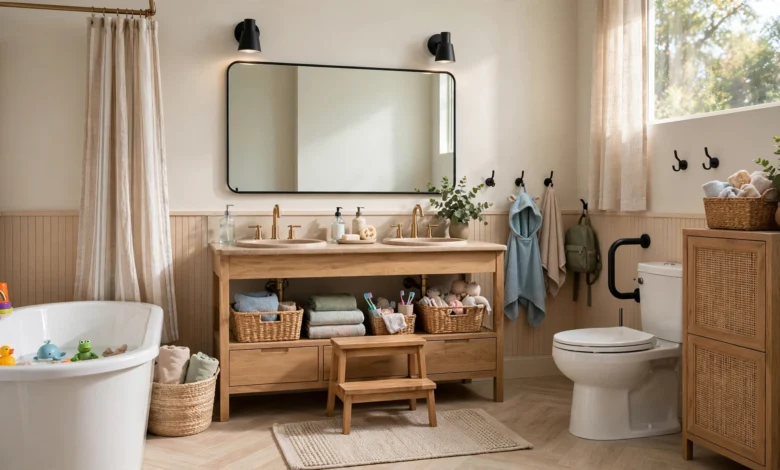
If your bathroom serves more than one child, or a child and a parent getting ready at the same time, a double vanity solves more morning conflict than almost any other single upgrade. Even a single wide vanity with two basins set at slightly different heights, one standard and one lower, works well for households with a wide age range.
- Improved functionality: two people can brush teeth or wash up at once
- Extra mirror space reduces waiting during busy routines
- Increased storage keeps each family member’s items separated and organized
5. Choose Storage That Kids Can Actually Use
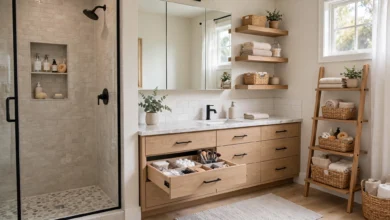
Storage is where a lot of family bathrooms fall apart, not because there isn’t enough of it, but because it’s designed for adult reach and adult habits. Drawers work better than closed cabinets for young children, since they can see and reach what’s inside without help.
- Shallow drawers near sink height for toothbrushes, toothpaste and hairbrushes
- Deeper drawers or baskets for bath toys, towels and spare supplies
- Locked or high cabinets for medicine, razors and cleaning products, kept well out of reach
- A pull-out step stool tucked beneath the vanity so kids can reach the sink independently
Labeling sections or using a separate basket for each child cuts down on the daily “where’s my toothbrush” scramble more than most parents expect.
6. Set the Right Vanity and Counter Height
A vanity that’s comfortable for adults is often too high for young children to use without help. Where possible, aim for a vanity height in the 34 to 36 inch range with a sturdy step stool or built-in step drawer, which lets kids wash their hands and brush their teeth independently rather than needing to be lifted every time.
If a full lower vanity isn’t practical, a well-designed step stool that tucks neatly away when not in use achieves nearly the same result without a major layout change.
7. Add Hooks, Not Just Towel Bars
Young children rarely manage to fold a towel over a bar, but they can usually manage a hook. A row of towel hooks at a lower height, one per family member, keeps wet towels off the floor and gives each child a designated spot, which does more for tidiness than any storage cabinet.
For households with multiple kids sharing a bathroom, color-coded or labeled hooks make it easy for even young children to know which towel is theirs.
8. Choose Durable, Easy-to-Clean Materials
A family bathroom takes more daily wear than almost any other room in the house, so durability should weigh as heavily as appearance when choosing finishes.
- Wipeable paint: satin or semi-gloss finishes hold up to fingerprints, splashes and the occasional bath-time art project far better than flat matte paint
- Non-porous countertops: quartz or solid surface materials resist staining and are simple to wipe down
- Smooth shower surfaces: fewer grout lines and simpler enclosure designs cut down significantly on cleaning time
- Soft-close drawers and cabinets: reduce slammed fingers and general wear on cabinetry over time
9. Layer Your Lighting for Safety and Function
Good lighting in a family bathroom does double duty: it makes the space safer to navigate and easier to actually use for grooming and hygiene tasks. A single overhead fixture rarely provides enough even coverage.
- Overhead lighting for general illumination
- Vanity lighting positioned to reduce shadows on the face
- A soft night light or motion-sensor light for safe nighttime trips, particularly useful for toddlers and older family members alike
- Frosted windows or a skylight where privacy and natural light both matter
10. Choose Fixtures That Adapt as Kids Grow
One of the smartest moves in family-friendly bathroom design is choosing fixtures that can evolve alongside your children rather than needing to be replaced every few years.
- A handheld showerhead on an adjustable bar works for bathing toddlers and showering teenagers alike
- Toilets with a removable child seat insert support potty training without a separate small toilet
- Single-lever faucets are easier for small hands to operate safely than traditional knob handles
- A floating vanity mounted at a height that works today can often be adjusted or paired with a step stool as your children grow taller
11. Plan for Different Life Stages Under One Roof
A bathroom designed purely around toddlers will feel cramped and juvenile within a few years, while one designed purely around adults may never feel comfortable for young children in the first place. The strongest family bathrooms plan intentionally for a range of ages.
- For young children: prioritize non-slip flooring, lower counters, rounded edges and childproof cabinet locks
- For teenagers: focus on privacy, durable surfaces and enough storage for their own toiletries and haircare tools
- For adults: prioritize quality fixtures, ample storage and a layout that doesn’t feel compromised by the family-friendly features around it
A bathroom that thoughtfully balances all three groups tends to age far better than one designed around a single stage of childhood.
12. Don’t Forget Ventilation
A well-used family bathroom generates more daily humidity than almost any other room, between baths, showers and multiple people getting ready each morning. A properly sized, properly vented exhaust fan protects your finishes and indoor air quality, and it matters just as much in a family bathroom as it does anywhere else in the house. According to guidance frequently cited by pediatric health resources such as HealthyChildren.org, maintaining good bathroom ventilation also helps reduce mold exposure, a genuine concern for households with young children or anyone with respiratory sensitivities.
13. Balance Practicality With a Little Bit of Fun
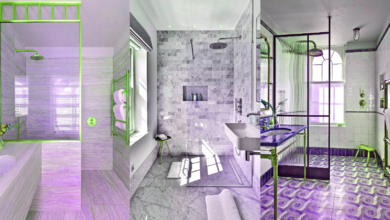
Practicality doesn’t have to mean boring. A family-friendly bathroom can still have personality, whether that’s a playful tile pattern in the shower, a bold accent wall, or simply colorful, easy-to-swap accessories like bath mats and shower curtains that can change as your kids’ tastes evolve. Fun design touches that don’t compromise safety or durability, like a graphic floor tile or a cheerful paint color on cabinetry, keep the space feeling inviting rather than purely functional.
Common Mistakes to Avoid in Family Bathroom Design
- Choosing polished, high-shine flooring that becomes dangerously slippery when wet
- Skipping anti-scald devices on tubs and showers used by young children
- Relying on closed cabinets instead of drawers for everyday kids’ items
- Under-lighting the space, which makes both safety and daily grooming tasks harder
- Designing entirely around toddlers without planning for how the room will function once they’re teenagers
Final Thoughts
A well-designed family-friendly bathroom comes down to balancing safety, storage and flexibility so the space genuinely works for everyone in the household, not just one age group. Start with the safety fundamentals, zone the room sensibly, choose storage and fixtures your youngest family members can actually use, and pick durable materials that hold up to years of daily traffic. Handled thoughtfully, a family bathroom doesn’t need a full renovation every time your kids hit a new stage, it simply grows with them, staying safe, functional and genuinely pleasant to use for the whole family for years to come.