18 Outdoor Lighting Ideas That Transform Your Backyard
Outdoor lighting ideas that transform your backyard, covering pathway lights, ambient fixtures, accent lighting, and smart options.
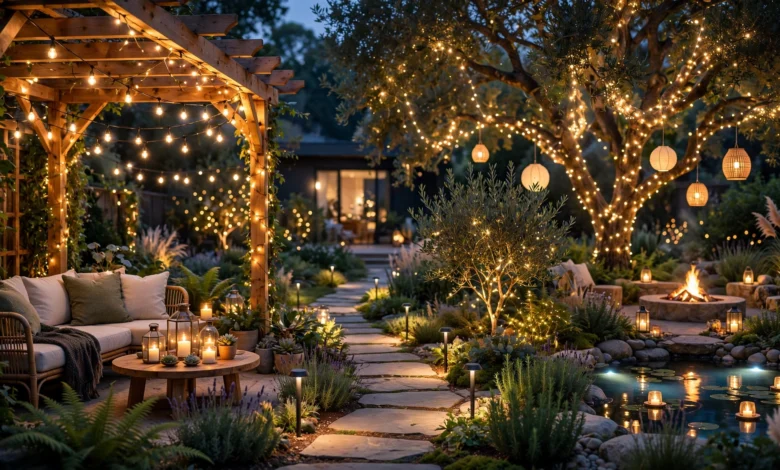
Outdoor Lighting Ideas That Transform Your Backyard: 18 Bright Ways to Upgrade Your Space
Introduction
Outdoor lighting ideas that transform your backyard don’t need to be complicated or expensive to make a real difference. A backyard that looks great during the day but goes completely dark at night is only being used for half of its potential hours. The right lighting extends usable time into the evening, adds a layer of safety around steps and pathways, and turns a plain patio or garden into a space that feels genuinely finished rather than half-done.
The challenge most homeowners run into isn’t a lack of options, it’s knowing which fixtures actually serve a purpose in their specific space versus which ones just add clutter. A backyard with too many mismatched light sources can look busier and less inviting than one with a few well-placed, purposeful fixtures.
This guide walks through eighteen practical outdoor lighting ideas, organized by function: safety and pathway lighting, ambient lighting for entertaining, accent lighting that highlights specific features, water and fire lighting, and smart or sustainable options worth considering. Each one is explained in enough detail to help you decide whether it fits your space, your budget, and how you actually use your backyard. By the end, you’ll have a clear sense of which combination of these ideas will do the most for your specific outdoor space, rather than a generic list of fixtures without context.
Why Outdoor Lighting Matters More Than People Expect
Before getting into specific ideas, it’s worth noting why lighting deserves real planning rather than an afterthought. According to the U.S. Department of Energy’s guidance on LED lighting, LED fixtures now offer significantly better energy efficiency and longevity than older outdoor lighting technology, which makes investing in a proper layered lighting plan more practical than it used to be, both in terms of ongoing cost and the number of fixture options available.
Good lighting also does more than look nice. It improves safety around steps, uneven paving, and pool edges, and it can act as a deterrent for anyone considering trespassing on a poorly lit property. With that functional case established, here are the eighteen outdoor lighting ideas worth considering.
Safety and Pathway Lighting
Safety-focused lighting should generally be the starting point for any backyard lighting plan, since it serves a genuine functional purpose beyond aesthetics.
1. Path Lights
Low, staked path lights along a walkway guide movement through the yard after dark and help prevent trips on uneven ground. Spacing them evenly, roughly six to eight feet apart, gives consistent illumination without creating an overly bright runway effect.


2. Step and Stair Lighting
Recessed lights built into deck stairs or built-up garden steps address one of the most common outdoor safety hazards. These are typically low-voltage and can be wired into a broader outdoor lighting circuit or run on battery power for smaller projects.
3. Motion-Sensor Security Lighting
Motion-activated fixtures near entry points, side gates, or dark corners of the property add a practical security layer. Pairing a bright motion-sensor light with softer ambient lighting elsewhere avoids the space feeling like it’s lit for a security checkpoint rather than an outdoor living area.
Ambient Lighting for Entertaining
Ambient lighting is what makes a backyard feel warm and usable for dining or relaxing in the evening, rather than just visible.
4. String Lights or Festoon Lighting
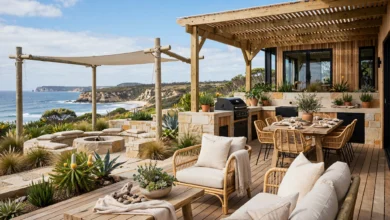
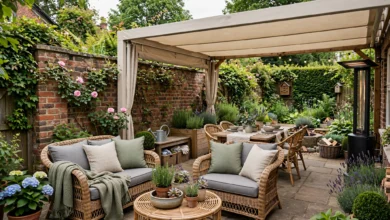
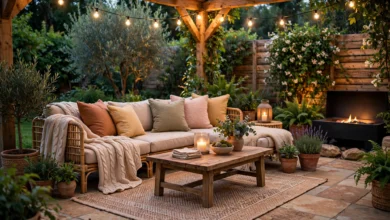
String lights remain one of the most popular and effective outdoor lighting ideas for a reason. Strung across a pergola, along a fence line, or between two posts, they create broad, warm ambient light without the harshness of a single overhead fixture.
5. Wall Sconces
Mounted on an exterior wall near a patio or entry, sconces provide steady ambient light and add an architectural detail to the house itself, particularly useful for spaces close to the building where a staked fixture isn’t practical.
6. Lanterns and Candles
Freestanding lanterns, whether battery-powered LED or traditional candle-lit, add a softer, more intimate layer of light to a dining table or seating area. They’re inexpensive, portable, and easy to move around as needed for different occasions.
7. Pergola-Integrated LED Strips
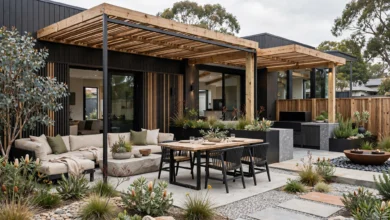
Running LED strip lighting along the underside of pergola beams creates a clean, built-in look without visible cords or hanging fixtures. This works particularly well for a more modern aesthetic where exposed string lights might not fit the overall design.
8. Recessed Lanai or Patio Lighting
For covered outdoor spaces, recessed ceiling fixtures offer a cleaner alternative to hanging lights, distributing even ambient light across the whole seating or dining area without visual clutter overhead.
Accent Lighting to Highlight Key Features
Accent lighting draws attention to specific elements of the yard, adding depth and visual interest after dark that a flat wash of ambient light doesn’t achieve on its own.
9. Tree Uplighting
Placing a spotlight at the base of a tree, angled upward through the branches, creates dramatic shadow and texture on the trunk and canopy. This is one of the more visually striking outdoor lighting ideas and works particularly well on mature trees with interesting branch structure.
10. Moonlighting
The opposite technique, mounting a downward-facing light high in a tree canopy, casts a soft, dappled light pattern on the ground below, mimicking natural moonlight. It’s subtler than uplighting and tends to suit larger properties with taller trees.
11. Architectural Spotlighting
Aiming a fixture at a specific wall texture, a stone feature, or an architectural detail on the house draws the eye and adds depth to the overall composition of the yard at night.
12. Garden Bed Accent Lights
Small, low-profile spotlights tucked into garden beds highlight specific plantings or sculptural elements, adding visual layers to a garden that would otherwise disappear into darkness after sunset.
Water and Fire Feature Lighting
Water and fire features already draw attention during the day; lighting them properly extends that appeal into the evening.
13. Underwater Pool Lighting
LED pool lights, available in both fixed white and color-changing options, transform a pool from a dark, uninviting shape at night into a genuine visual centerpiece. Color-changing options in particular add a strong entertaining element for evening gatherings.
14. Fountain and Water Feature Lighting
Small submersible lights placed in a fountain, pond, or water wall add both illumination and a sense of movement, since the light interacts with the moving water in a way that static lighting doesn’t replicate.
15. Fire Pit and Fireplace Lighting
A fire pit or outdoor fireplace is a light source in its own right, but supplementing it with subtle surrounding lighting, rather than relying on the fire alone, keeps the broader seating area usable and safe once the flames die down later in the evening.
Smart and Sustainable Lighting Options
Lighting technology has improved significantly, and a few modern options are worth considering for both convenience and long-term cost.
16. Solar Path and Accent Lights
Solar-powered fixtures have become considerably more reliable and brighter than earlier generations, and they avoid the cost and complexity of running new electrical wiring. They work best in locations that get consistent direct sunlight during the day, since shaded areas will limit their charge and brightness.
17. Smart, App-Controlled Lighting
Smart outdoor lighting systems, controlled through a phone app or voice assistant, allow scheduling, dimming, and even color adjustments without manually operating switches. This is particularly useful for larger properties with multiple lighting zones, since it centralizes control rather than requiring separate switches for each area. The American Lighting Association offers consumer guidance on choosing and planning smart lighting systems suited to different outdoor spaces and budgets.
18. Color-Changing LED Systems
For homeowners who entertain frequently or want flexibility for different occasions, color-changing LED systems, often controlled through the same app as smart lighting, allow the whole backyard’s lighting scheme to shift for a party, a holiday, or simply a different mood on a quiet evening.
How to Combine These Ideas Without Overdoing It
With eighteen options on the table, it’s worth being deliberate about which combination actually suits your space rather than trying to include all of them. A well-planned backyard lighting scheme typically layers three types of light:
- A safety layer, covering paths, steps, and entry points.
- An ambient layer, providing general warmth and usability across the main gathering areas.
- An accent layer, drawing attention to a few chosen features, trees, water, architecture, without overloading the space.
Trying to include every accent and feature idea in one yard usually results in a cluttered, overly bright space rather than the warm, inviting effect most people are actually going for. Choosing a handful of ideas from each layer, suited to your yard’s specific features and how you use the space, tends to produce a much more cohesive result.
Budget Considerations
Not every idea on this list requires a significant investment, and a phased approach is often the most practical way to build out a full lighting plan.
- Lower-cost starting points: solar path lights, string lights, lanterns and candles, and simple stake-mounted accent lights.
- Mid-range additions: wired step lighting, wall sconces, and pergola-integrated LED strips.
- Larger investments: underwater pool lighting, smart app-controlled systems, and any lighting requiring professional electrical wiring.
Starting with the safety layer, since it’s both functional and often the least expensive to add, and building outward toward ambient and accent lighting over time is a reasonable way to spread the cost while still improving the space with each addition.
Conclusion
Outdoor lighting ideas that transform your backyard don’t require installing every fixture on this list at once. A thoughtful combination of safety lighting along paths and steps, warm ambient lighting for the main gathering areas, and a few well-chosen accent lights on trees, water features, or architectural details is usually enough to turn a backyard that goes dark at sunset into a space that’s genuinely usable well into the evening. Whether you start with a simple string of lights or work toward a full smart lighting system, the goal stays the same: layered, purposeful light that makes the space feel finished rather than an afterthought once the sun goes down.