Kitchen & Dining Ideas for a Modern Luxury Home
Kitchen & dining ideas for a modern luxury home: layouts, materials, lighting and finishes that create a refined, high-end living space.
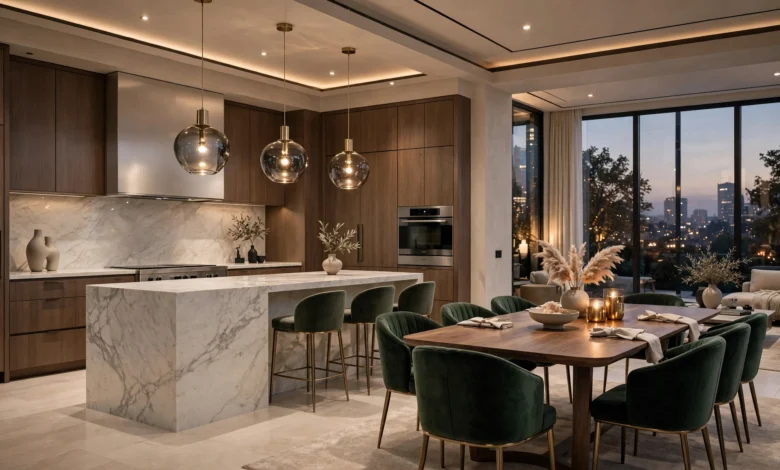
Kitchen & Dining Ideas for a Modern Luxury Home
Kitchen & dining ideas for a modern luxury home go well beyond expensive appliances and marble countertops. The kitchens that actually read as luxurious, the kind that feel calm and considered rather than showy, are built on restraint: clean lines, quality materials, thoughtful lighting, and a layout that works as hard as it looks good. A truly high-end kitchen and dining space isn’t defined by how much it cost. It’s defined by how well every decision serves the way you actually live and entertain.
This guide breaks down what separates a genuinely luxurious kitchen and dining area from one that simply looks expensive in photos. We’ll cover layout principles, material choices, lighting strategy, and the design details that give a space its sense of quality, along with a few practical considerations that often get overlooked in glossier design articles, like ventilation, storage, and how to blend luxury with sustainability rather than treating them as opposites.
Whether you’re designing a custom build from scratch, planning a full renovation, or simply want to refresh an existing kitchen and dining space to feel more elevated, the ideas here are grounded in design principles that hold up well beyond a single season’s trend cycle. The goal isn’t a kitchen that photographs well once. It’s one that still feels right in ten years.
What Defines a Modern Luxury Kitchen & Dining Space?
Before getting into specific ideas, it helps to define what “luxury” actually means in a kitchen and dining context, because it’s rarely about the price tag alone. A genuinely luxurious space tends to share a few consistent traits:
- Restraint over excess. The most refined kitchens use fewer materials, chosen carefully, rather than layering on every high-end finish available.
- Seamless, handleless cabinetry that keeps sightlines clean and lets a few statement elements, like an island or a lighting fixture, take center stage.
- A considered flow between kitchen and dining. Luxury spaces are designed to move naturally from cooking to entertaining to gathering, not treated as two disconnected rooms.
- Materials with depth and texture, such as natural stone, warm wood, and matte metal finishes, rather than surfaces chosen purely for shine.
- Quality over quantity in lighting and fixtures, with a few carefully chosen statement pieces rather than a scattergun approach.
1. Choose a Layout Built for Both Cooking and Entertaining
Layout is the foundation of any kitchen and dining design, and in a luxury home it needs to work for two different modes: efficient daily cooking and relaxed entertaining.
The Kitchen Work Triangle, Modernised
The classic layout principle, keeping the refrigerator, sink, and stove within easy reach of one another, still holds up well in modern luxury kitchens, particularly in U-shaped and G-shaped layouts that maximise counter space and storage. The National Kitchen and Bath Association continues to reference this triangle as a core planning principle, even as kitchens have expanded to include more zones for entertaining.
The Modern Addition: Zones, Not Just Triangles
Beyond the classic triangle, luxury kitchens increasingly plan around distinct functional zones:
- A prep zone with the sink and primary worktop
- A cooking zone built around the range or cooktop
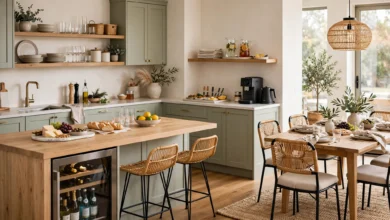
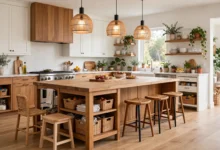
- A social zone, usually the island, where guests gather while you cook
- A beverage or bar zone, often a secondary counter with a wine fridge or coffee station, separate from the main workflow
Open-Plan Kitchen and Dining Layouts
An open connection between kitchen and dining space remains one of the most requested features in luxury homes, since it keeps the household connected during meal prep and creates a naturally larger, more sociable room. If privacy or noise containment matters, a partial divider, such as a slatted timber screen or a half-height stone wall, offers separation without fully closing the space off.
2. Invest in Statement Materials, Chosen Sparingly
Luxury materials make the biggest impact when they’re used intentionally rather than everywhere at once.
Countertops and Islands
- Natural stone, such as marble or quartzite, remains the benchmark for a luxury kitchen island, particularly with a waterfall edge that carries the veining down the side of the island uninterrupted
- Engineered stone offers a similar high-end look with better durability and stain resistance for busy family kitchens
- Mixing stone types between the island and perimeter counters adds visual depth without overwhelming the room
Cabinetry Finishes
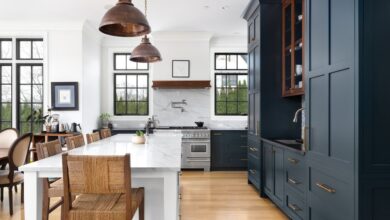
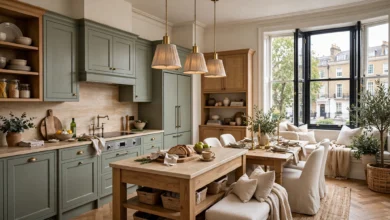
- Matte or textured cabinetry in deep, moody tones like charcoal, forest green, or deep wine reads as far more luxurious than high gloss
- Two-tone cabinetry, pairing a darker island with lighter perimeter cabinets, is one of the most effective ways to add contrast without visual clutter
- Handleless, push-to-open cabinetry keeps lines clean and reinforces the minimal, high-end aesthetic
Warm Materials to Balance the Palette
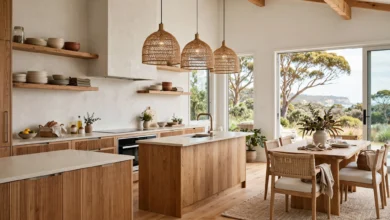
Stone and matte cabinetry can feel cold without a warming counterpoint. Wood accents, whether on open shelving, a ceiling detail, or a dining table, add the warmth that keeps a luxury kitchen feeling inviting rather than showroom-sterile.
3. Design Lighting as a Feature, Not an Afterthought
Lighting has an outsized effect on how luxurious a kitchen and dining space actually feels, and it’s one of the easiest things to underinvest in.
- Statement pendant lighting over an island or dining table instantly elevates the room, whether that’s a sculptural fixture or a cluster of smaller pendants
- Layered lighting combining task lighting under cabinets, ambient ceiling light, and accent lighting inside glass-front cabinetry adds depth after dark
- Dimmable circuits throughout the kitchen and dining zone, so the space can shift from bright and functional during meal prep to soft and atmospheric for a dinner party
- Under-cabinet and toe-kick lighting for a subtle glow that makes the room feel considered even with the main lights off
4. Bring the Dining Space Up to the Same Standard
A luxury kitchen loses its impact if the dining area feels like an afterthought. The two spaces should read as a single, cohesive design.
A Considered Dining Table
- Choose a table material that echoes something already in the kitchen, whether that’s a matching stone top or a wood tone that ties back to cabinetry or flooring
- Scale the table to the room rather than maximising seating capacity; a slightly smaller table with breathing room around it reads as more refined than one crammed against the walls
- Mix seating where it makes sense, such as upholstered dining chairs on one side and a bench on the other, for a layered, designed-not-decorated feel
Sightlines Between Kitchen and Dining
In an open-plan luxury home, think about what’s visible from the dining table while seated. A well-placed island, a considered view toward a feature wall, or glazing that frames an outdoor space all add to the sense of an elevated, intentional room.
5. Choose Appliances That Balance Performance and Design
High-end appliances matter in a luxury kitchen, but the best choices integrate rather than dominate.
- Integrated or panel-ready appliances that match surrounding cabinetry keep the kitchen looking cohesive rather than like a showroom of separate brands
- Professional-grade ranges remain a strong focal point where cooking is a genuine priority, but they should be sized to the kitchen rather than chosen purely for status
- Energy-efficient appliances are increasingly part of what defines a genuinely well-specified luxury kitchen, both for lower running costs and for sustainability. The ENERGY STAR program is a useful reference point when comparing efficiency ratings across appliance categories
6. Prioritise Storage That Doesn’t Compromise the Look
A luxury kitchen should feel uncluttered without sacrificing function, which means storage needs to be planned as carefully as any visible surface.
- Full-height pantry cabinetry, ideally concealed behind matching panel fronts, keeps everyday clutter out of sight
- Deep, soft-close drawers for cookware, sized to the specific items they’ll hold rather than generic dimensions
- Integrated appliance garages for smaller countertop appliances, keeping benchtops clear when they’re not in use
- Dedicated bar or beverage storage, particularly useful in homes that entertain regularly, separate from everyday kitchen storage
7. Blend Luxury With Sustainability
A modern luxury kitchen doesn’t have to come at the expense of environmental responsibility, and increasingly, the two go hand in hand.
- Sustainably sourced natural stone and timber, chosen from suppliers who can verify responsible sourcing
- Water-efficient fixtures, including tapware and dishwashers rated for lower water use without sacrificing performance
- Durable, long-lasting materials that reduce the need for future replacement, which is itself a form of sustainability
- Energy-efficient lighting, particularly LED fixtures, which now come in warm tones that suit a luxury aesthetic without the harshness once associated with LED lighting
8. Avoid These Common Mistakes in Luxury Kitchen Design
Even with a generous budget, a handful of missteps show up repeatedly in kitchen and dining renovations aiming for a high-end result:
- Over-layering finishes so no single material gets to stand out, which reads as cluttered rather than luxurious
- Prioritising a large island over comfortable circulation space, which makes the kitchen harder to actually use
- Choosing trend-led colours or finishes that will feel dated well before the rest of the home does
- Underinvesting in lighting relative to materials and appliances, despite lighting having an outsized visual impact
- Treating the dining area as a separate project, rather than designing it to match the kitchen’s material and lighting language
Frequently Asked Questions
What makes a kitchen feel luxurious without being overdesigned? Restraint. A small number of high-quality materials, used consistently and paired with strong lighting, reads as far more luxurious than a kitchen with too many competing finishes.
Is an open-plan kitchen and dining layout still considered a luxury feature? Yes. Open-plan layouts remain highly desirable in luxury homes because they support entertaining and keep the household connected, though partial dividers are increasingly used to add flexibility.
Do luxury kitchens need professional-grade appliances? Not necessarily. Integrated, well-specified appliances that suit how the household actually cooks generally make more sense than oversized professional equipment chosen purely for appearance.
How can a luxury kitchen be more sustainable? Choosing responsibly sourced materials, energy-efficient appliances, and water-efficient fixtures allows a kitchen to feel high-end while reducing its environmental footprint.
Conclusion
Kitchen & dining ideas for a modern luxury home ultimately come down to intentional decisions rather than an unlimited budget. A layout that supports both cooking and entertaining, a small number of carefully chosen materials, layered lighting treated as a design feature in its own right, and a dining space designed to match the kitchen’s quality all combine to create a room that feels genuinely elevated. Add sustainable, well-specified appliances and storage that keeps the space uncluttered, and you get a kitchen and dining area that doesn’t just look luxurious in photos, but holds up to daily life and still feels considered years down the line.
Keywords: