Living Room Ideas for Homes in Manchester and Leeds
Living room ideas built for Manchester and Leeds homes, from bay windows to alcove storage, that suit period terraces and new builds alike.
9 Practical Living Room Ideas for Homes in Manchester and Leeds
Living room ideas that work well in a magazine spread don’t always translate to a red-brick terrace in Chorlton or a stone-fronted semi in Headingley. Homes across Manchester and Leeds come with their own quirks: bay windows, narrow floor plans, chimney breasts with awkward alcoves on either side, and rooms that were built for a different century’s furniture and lifestyle. Getting the living room right here means working with those features rather than fighting them.
Both cities share a lot of housing DNA. Victorian and Edwardian terraces make up a huge share of the stock in areas like Chorlton, Didsbury, Hyde Park, and Chapel Allerton, while newer developments around Salford Quays and Leeds Dock bring open-plan layouts that need a completely different approach. What suits a compact terrace living room rarely suits a loft-style apartment, and copying a Pinterest board designed for a large American living room usually leaves you with furniture that doesn’t fit and storage that doesn’t solve anything.
This guide covers nine living room ideas for homes in Manchester and Leeds specifically, built around the actual layouts, light, and architecture you’re likely working with. Some ideas are quick weekend fixes, others are worth planning around if you’re mid-renovation. All of them are meant to make a real room work better, not just look better in a photo.
1. Work With Your Bay Window, Don’t Block It
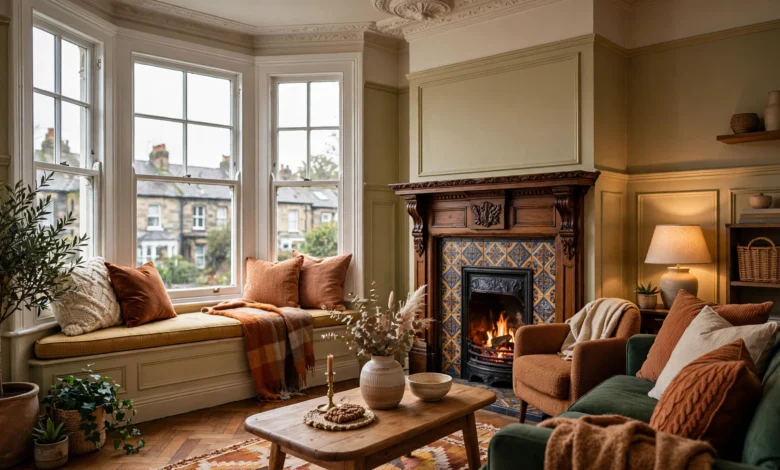
If your home was built any time between the 1880s and the 1930s, there’s a good chance your living room has a bay window, and it’s one of the most useful features in the room if you use it properly.
A few ways to make a bay window earn its keep:
- Built-in bench seating with storage underneath turns unused floor space into extra seating and hides blankets, toys, or board games out of sight
- A single armchair angled into the bay creates a reading nook that doesn’t crowd the main seating area
- Roman blinds or fitted shutters suit the shape of a bay far better than standard curtain poles, which often hang awkwardly around the curve
Bay windows also bring in useful natural light from an angle most rooms don’t get, so avoid heavy, dark curtains that block it during the day. According to design guidance from Homebuilding & Renovating on terraced house living rooms, treating a bay as a distinct zone rather than an extension of the main seating area helps a narrow terrace living room feel less like one long, undivided space.
2. Turn Chimney Breast Alcoves Into Storage
Almost every period terrace in Manchester and Leeds has a chimney breast running through the living room, with an alcove on either side. Left empty, these recesses are wasted space. Fitted properly, they become some of the most useful storage in the house.
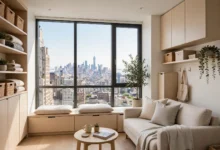
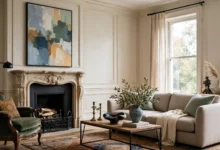
Options worth considering for alcove space:
- Floor-to-ceiling fitted shelving, painted to match the walls so it reads as part of the room’s architecture rather than an added piece of furniture
- Low cupboards with a shelf above, giving you closed storage for clutter and open display space for books or décor
- A slim media unit on one side, keeping the TV off the chimney breast itself and freeing up the wall above the fireplace for art or a mirror
This is one of the highest-value changes you can make in a period property, since it uses space that would otherwise sit empty and adds real storage without extending the footprint of the room.
3. Choose Furniture Scaled for Narrow Rooms
Terraced living rooms across both cities tend to run long and narrow rather than square, often no more than 3.5 to 4 metres wide. Furniture bought for a showroom display, where everything is arranged in a large open space, often ends up too bulky once it’s back in a terrace.
A few sizing guidelines that help:
- A two-seater or compact three-seater sofa usually fits better than a full three-seater plus armchair combination in rooms under 4 metres wide
- Slim-arm or track-arm sofas save 10-15cm of width per side compared with rolled-arm designs, which adds up in a tight room
- Nesting or narrow console tables work better than a single large coffee table, since they can be pulled apart for extra surface space or pushed together when not needed
If you’re unsure whether a piece will fit, mark out its footprint on the floor with masking tape before you buy. It sounds basic, but it catches sizing mistakes that are easy to make from a product photo alone.
4. Plan Layered Lighting for Dark Terrace Rooms
Many terraced houses in Manchester and Leeds only have windows at one end of the living room, which leaves the far end noticeably darker, especially in a room that runs front to back. A single central ceiling light rarely solves this evenly.
A layered approach works better:
- A pendant or flush fixture for general light, ideally on a dimmer so it can flex between daytime brightness and evening ambience
- A floor lamp at the darker end of the room, filling in the shadow that the window end doesn’t reach
- Table lamps near seating, adding warmth and making the room usable without the main light on at all
The Energy Saving Trust’s home lighting advice also points out that combining a few lower-wattage fixtures rather than one large one tends to use less electricity overall while giving you more control over how the room feels at different times of day, which matters in a city where the light changes quickly between seasons.
5. Pick a Colour Palette That Suits Northern Light
Manchester and Leeds don’t get the same volume of direct sunlight as homes further south, and the light that does come in tends to be cooler and greyer for a large part of the year. Colour choices that look warm and inviting in a bright showroom can end up looking flat or cold in a north-facing terrace.
A few palette approaches that tend to work well locally:
- Warm neutrals like putty, warm greige, or soft terracotta counteract cooler daylight better than stark white or cool grey
- Deep, saturated colours on a chimney breast or single wall add warmth and make a room feel cosier during the darker months, which cover a good chunk of the year here
- Matte or soft-sheen paint finishes reflect light more gently than high-gloss finishes, which can look harsh under artificial lighting once the sun goes down
Testing paint samples on the wall at different times of day, rather than relying on how a colour looks in the tin or on a screen, matters more in this kind of light than almost anywhere else.
6. Make Open-Plan Layouts Feel Zoned
Newer builds around Salford Quays, Ancoats, Leeds Dock, and the wider city-centre apartment developments often come with open-plan living and dining space rather than a separate living room. Without some kind of division, these spaces can feel like one undefined room rather than a proper lounge.
Ways to create a sense of separation without adding walls:
- A rug under the sofa and coffee table visually marks out the seating area, even in a room that flows straight into the kitchen or dining space
- A console table or open bookshelf behind the sofa acts as a soft boundary between zones without blocking light or sightlines
- A pendant light over the dining table, distinct from the living area’s lighting, reinforces that the two spaces serve different purposes
This kind of zoning matters more in open-plan flats than in period terraces, where the walls have already done that job for you.
7. Add Texture Through Soft Furnishings
Whether you’re in a Victorian terrace or a new-build apartment, soft furnishings are the easiest way to update a living room without any structural work. Cushions, throws, and rugs are also the cheapest place to experiment if you’re not ready to commit to a paint colour or a new sofa.
A few combinations that hold up well over time:
- Boucle or wool cushions paired with a linen sofa add texture without clashing patterns
- A wool or wool-blend rug handles the wear of daily use better than flatweave cotton in a well-used family living room
- Layered throws in two or three tones of the same colour family add depth without looking mismatched
These changes are also the fastest way to refresh a room seasonally, swapping out lighter tones and fabrics in summer for heavier, warmer textures once the weather turns, which happens earlier in the north than in most of the country.
8. Bring in Local Character Through Materials
Both Manchester and Leeds have strong industrial and architectural histories, and a lot of homeowners find that leaning into that, rather than trying to erase it, gives the living room more personality than a generic, catalogue-style scheme.
A few ways to bring that character in:
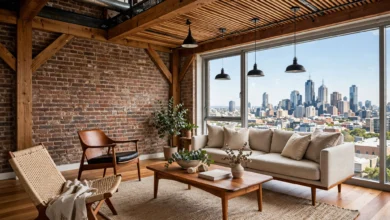
- Exposed brick, where it exists behind plaster in older terraces, can be a striking feature wall if it’s structurally sound and properly sealed
- Reclaimed or dark-stained wood furniture echoes the mill and warehouse conversions common across both cities
- Cast iron or reproduction Victorian fireplaces, even non-working ones with an electric insert, keep a period feature relevant in a modern room
This approach tends to age better than following a trend that will look dated in a few years, since it’s tied to the building itself rather than a passing style.
9. Solve for Storage Before Buying Furniture
Storage is consistently the biggest complaint in smaller terraced living rooms across both cities, and it’s usually easier to fix at the planning stage than after the furniture has already arrived.
A short checklist worth working through before buying anything new:
- List what actually needs to live in the living room day to day (remotes, chargers, throws, kids’ toys, books) before choosing furniture
- Prioritise pieces that do two jobs, like a coffee table with an internal shelf or an ottoman that opens for storage
- Use vertical space wherever floor space is tight, since narrow terrace rooms almost always have more wall height to work with than floor area
Getting storage sorted first tends to prevent the most common mistake in small living rooms: buying furniture that looks right in isolation but leaves nowhere for everyday clutter to go.
Frequently Asked Questions
What’s the biggest layout challenge in Manchester and Leeds living rooms? Narrow, elongated room shapes are the most common issue, especially in Victorian and Edwardian terraces, which is why furniture scale and zoned lighting matter more here than in wider, squarer rooms.
Are bay windows worth keeping in a renovation? Yes, in most cases. Bay windows add natural light and character that’s expensive to replicate, and they’re generally easier to work around with furniture than to remove.
Do open-plan new builds need different living room ideas than period terraces? Largely yes. Open-plan spaces need visual zoning to define the living area, while terraces already have that separation built in through walls and need more focus on light and storage instead.
Conclusion
Good living room ideas for homes in Manchester and Leeds start with the building itself, whether that’s a Victorian terrace with a bay window and chimney breast alcoves or a newer open-plan flat that needs some visual zoning to feel like a proper lounge. Working with bay windows and alcoves instead of ignoring them, scaling furniture to genuinely narrow rooms, layering lighting to handle darker corners, and choosing colours that hold up under northern light all make a bigger difference than chasing a generic design trend. Start with whichever of these feels most relevant to your own room, whether that’s sorting storage before buying new furniture or finally doing something useful with an empty alcove, and the rest tends to follow naturally from theri.